Showing posts with label equality. Show all posts

Tuesday, 29 May 2012

Gini mac


How I imagined it would be: Enda Kenny, as leader of the new government, would stand up in the Dáil on his first day and announce: "We're all in this together. We have to solve it together. For the duration of the crisis, all government and public service and semi-state salaries are being cut to €50,000. No expenses, no increments, no massive pensions, no double pensions, no free bars or canteens."
He would say: "We were a poor country until the 1970s, then we began to climb out of it. The reasons were education - we opened free, State-supported education for all to the Leaving Cert, and then university - and a new egalitarianism that allowed talented people to follow their gift, and brought investment flying into the country.
"So now we're going to follow the same plan. We will keep and use our assets, foster our talent, grow our industries. Like Japan, we will become a country of SMEs, exporting to our neighbours; like Iceland, we will send the gambling banks off with a flea in their ear."
I expected him to fight to take back the fishing grounds that horrifyingly stupid EU policies have ruined - we have some of the best marine expertise in the world in Ireland, who could save the species now threatened with extinction. I expected Enda to keep our forests as a national heritage, to foster our arts, to put the best brains in the country to work in our enterprise management.
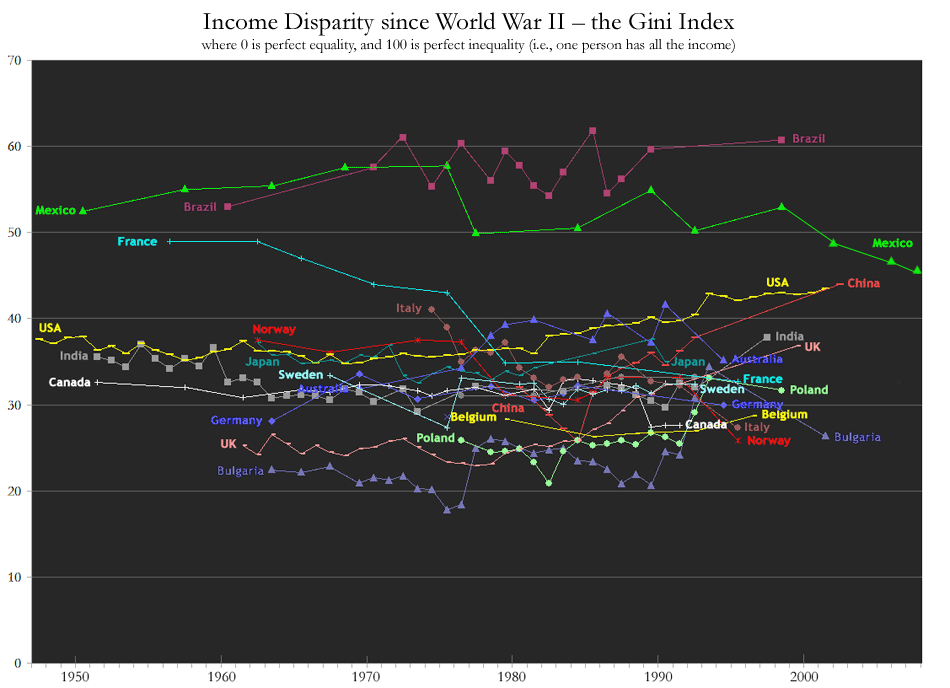
Ireland's Gini Coefficient, Corrado Gini's measure of statistical dispersion, which measures equality of income, and which is a reliable indicator of the future success of a society, has been getting worse. A low Gini figure means an equal society, and also indicates a society where people have equal chances, resulting in better healthcare, lower prison numbers, higher educational attainment, more overall wealth.
Here's a graph of how countries have been doing since World War II (being at the bottom of the chart means you're more equal, being at the top of the chart means you're less equal; if the Gini ratio is 100, one person has all the wealth, if it's 1, everyone has the same amount):

In Europe-wide figures Ireland in 2009 had achieved a Gini Coefficient of 28.8, creditably below the EU average of 30.4. Just a year later it had soared to 33.2. Figures are not yet available for 2011 and 2012, but there is no doubt that inequality is getting worse. http://appsso.eurostat.ec.europa.eu/nui/show.do?dataset=ilc_di12&lang=en
Our unemployment figures are rising, poverty is increasing - even though the real effect of this is concealed by the haemorrhaging emigration that removes huge numbers from the register of unemployment and the need for state support. 
I voted the straight left ticket in the general election, or so I thought. I was ecstatic that Labour would be in government - they would stand up for the poor, I thought, they would foster equality. I was happy that Fine Gael would lead the government; I thought they were straight and decent, and would understand that an equal society, a just society, is best for all. 
Better get back to writing fiction now.


  Lucille Redmond's ebook of short stories, Love, is available on Amazon and iTunes


Monday, 5 December 2011

Inequality: a social pollutant


DO YOU trust your neighbours? Do you lock your doors and windows up tight? Do you think you’re likely to be robbed on the street? If someone asked you whether you agreed with the statement ‘most people can be trusted’, how would you answer?
Don’t start. I know you’re going to go on about modern life and how kids can’t play in the road any more. 
It’s true - but not everywhere. In some countries, people answer those questions “I feel safe. I trust my neighbours. I’m unlikely to be robbed.” And they’re right, and not just about crime. They also have better health, higher education and longer lives.
Those countries may surprise you: Sweden, Norway, Finland,  Japan. All wealthy, but that’s not the reason they’re safe, according to two academics whose theory may change our attitude to wealth. 
Richard Wilkinson and Kate Pickett say the difference is how much more money a country’s rich have than that country’s poor. The countries that do badly are often surprising: the US, Portugal, Singapore.
You wouldn’t imagine that a study collating years of figures from the WHO, the UN, the OECD and other alphabetical luminaries would be entertaining, but Wilkinson and Pickett’s book Spirit Level has sold and sold. 
Wilkinson, a public health expert for almost 40 years, and University of York academic Pickett collated information from some 200 sources. 
Inequality - they say - affects everything from the number of people in prison to how long people live, to obesity, mental illness, teen births, drug use and violence. Countries where the richest are only a bit richer than the poorest do well. Countries where the rich have 300 times more than the poor are in big trouble. 
Ireland is fairly near the middle of the countries studied in total income - but just the wrong side of the middle in income distribution, Wilkinson told me. “Ireland has substantially lower life expectancy than we’d expect,” he says. “So your health is less good than we’d expect it to be. 
“Infant deaths are substantially higher - that might account for the low life expectancy. Only USA, Portugal and New Zealand have infant mortality as high or higher.”
Mind you, these figures are old - they’re from the early to mid 2000s. And the professors don’t have last year’s CSO figures - our infant mortality rate halved between 2000 and 2009. But as the gap between rich and poor widens in Ireland, our health care is likely to decline, our crime rise, and our educational standards fall - if the two academics’ figures hold true.
The weirdest thing Wilkinson and Pickett found was that bad outcomes in unequal nations hit the rich as well as the poor. Rich guys in countries with huge gaps between rich and poor live less long than rich guys in countries where everyone’s wealth is relatively level. 
“Some colleagues at Harvard called inequality a ‘general social pollutant’, because it seemed to lead to worse health amongst the whole population, not just the poor,” said Wilkinson.
If he’s right, someone had better call the water board, because as Ireland’s rich get richer and our poor get poorer, the social sewers are about to overflow. 
Evening Herald, May 2010